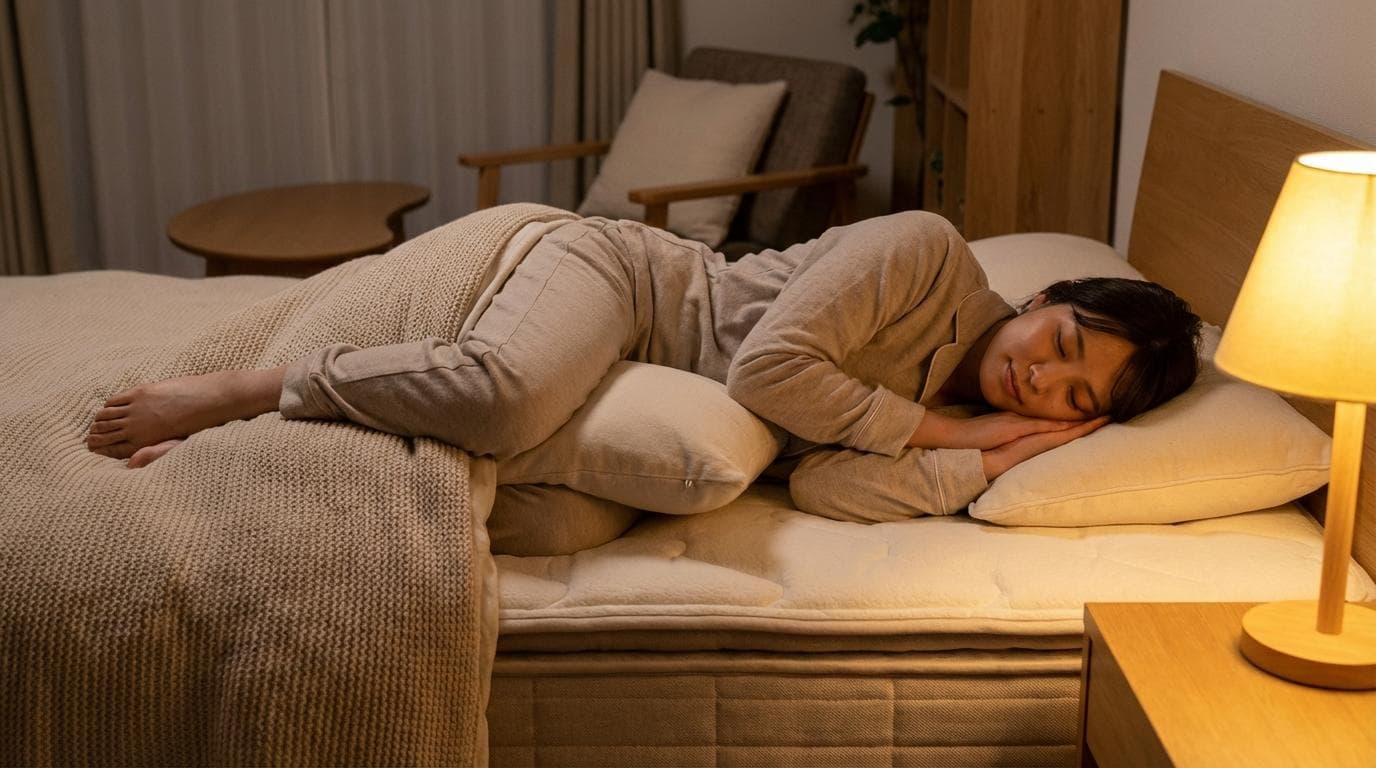
You fall asleep without much trouble. But somewhere around 3am, your eyes snap open. The room is dark. You're fully awake. And you know, with a sinking feeling, that sleep isn't coming back easily.
If this pattern happens more nights than not, you're not imagining things — and you're not alone. Waking up at 3am is one of the most commonly reported sleep complaints, and it has a name: early morning insomnia, or middle-of-the-night waking (MOTN). Unlike difficulty falling asleep, this particular pattern has a few consistent causes — most of which have nothing to do with stress or willpower.
Here's what's actually happening when you wake up at 3am, and what you can do about it.
Why Wake Up at 3am? The Biology of Sleep Architecture
To understand early morning insomnia, you need to understand how sleep is structured. Sleep isn't a flat, undifferentiated state — it cycles through distinct stages roughly every 90 minutes throughout the night.
Early in the night, your sleep is dominated by deep slow-wave sleep (SWS), the physically restorative phase. As the night progresses, the balance shifts: slow-wave sleep decreases and REM sleep — the mentally restorative, dream-rich stage — becomes longer and more frequent. By the early morning hours, your sleep is almost entirely composed of lighter REM cycles.
Here's the critical point: the transition between sleep cycles is the moment you're most likely to briefly wake up. Most people do this multiple times a night without noticing. But in the early morning hours, when sleep pressure (your biological drive for sleep) has been largely discharged and your body temperature is beginning to rise ahead of waking, these brief awakenings become full awakenings. Something — a noise, a racing thought, an anxious feeling — catches your conscious awareness, and you're up.
This is why 3am is such a consistent time for middle of night waking. It's not random. It's the natural architecture of sleep interacting with your specific biology.
The Dolphin Chronotype and Early Morning Insomnia
Not everyone is equally susceptible to 3am waking. People with what sleep researchers call a Dolphin chronotype — light, easily disrupted sleepers who tend toward anxiety and hyperarousal — are particularly prone to this pattern.
Dolphins often fall asleep later than they'd like and spend a significant portion of the night in lighter sleep stages. Their nervous systems stay partially activated even during sleep, which means any trigger — a sound, a temperature shift, a stress hormone — can pull them to full wakefulness. Then, crucially, their active minds take over: thoughts race, body sensations amplify, and the anxiety of being awake in the dark makes returning to sleep feel impossible.
If you're a Dolphin, the 3am awakening isn't a failure of your willpower. It's your nervous system doing exactly what it's wired to do. Understanding this matters because the solution isn't to try harder to sleep — it's to address the underlying hyperarousal.
Why Cortisol Explains Your 3am Wake Up
One of the most overlooked causes of early morning insomnia is the cortisol awakening response (CAR). Cortisol — your primary alerting hormone — naturally begins to rise in the early morning hours as your body prepares for waking. In most people this rise begins around 4-5am. But if you're under chronic stress, your cortisol rhythm can shift earlier or become exaggerated, triggering a full wake-up at 3am as your body misreads the signal.
High nighttime cortisol also keeps the brain's threat-detection system (the amygdala) partially online during sleep, which is why anxiety dreams, sudden jolts awake, and the sense of waking with your heart pounding often accompany this pattern. Your body is preparing to respond to a threat that isn't there.
This is why stress management during the day genuinely affects your 3am wake-up pattern — it's not just about what happens at bedtime.
Alcohol Is Robbing You at 3am
If you're having a glass of wine in the evening to wind down and still waking up at 3am, the alcohol is the likely culprit. This is one of the most reliable and underappreciated causes of middle of night waking.
Alcohol is sedating in the first half of the night — it genuinely helps many people fall asleep faster. But as the liver metabolizes the alcohol, the metabolic byproducts are alerting. The sedative effect wears off 3-4 hours after consumption, triggering a rebound arousal that typically occurs around — you guessed it — 3am.
This pattern is so consistent that sleep researchers use it as a diagnostic indicator. If your 3am waking correlates with evening drinking, the solution is straightforward: stop drinking within 3-4 hours of bed, or cut back overall. The waking typically resolves within a few days.
Blood Sugar and the 3am Wake Up
Another physiological cause that often gets missed: blood sugar fluctuations. If your blood sugar drops too low during the night — hypoglycemia — your body releases adrenaline to mobilize stored glucose. That adrenaline spike wakes you up.
This is more common in people who eat a low-carbohydrate diet, those who eat dinner very early, or anyone prone to reactive hypoglycemia. If you wake up at 3am feeling slightly shaky, hungry, or with a racing heart, blood sugar may be the cause.
A small complex-carbohydrate snack before bed — a handful of crackers, a small piece of fruit — can sometimes resolve this entirely. If it persists, it's worth discussing with your doctor.
Bedroom Temperature and Sleep Disruption
Your core body temperature drops during sleep and begins to rise in the early morning as part of the wake-up process. If your bedroom is too warm, this temperature rise happens too early and too dramatically, triggering early awakening.
The ideal sleep environment is cooler than most people keep it — between 65-68°F (18-20°C) for most adults. Even a few degrees too warm can shift the timing of early morning waking by an hour or two. If you tend to kick off blankets in the night or wake up warm, adjusting the room temperature is worth trying before anything else.
What Actually Works for Wake Up 3am Problems
The most evidence-backed treatment for middle of night waking is Cognitive Behavioral Therapy for Insomnia (CBT-I), particularly stimulus control and sleep restriction therapy. These techniques address the behavioral and psychological factors that maintain insomnia even after the original trigger resolves.
But there are several practical changes worth making first:
Keep your sleep window consistent. Going to bed and waking at the same time every day — including weekends — stabilizes your circadian rhythm and reduces early-morning arousal. Irregular schedules give your internal clock conflicting signals, which amplifies the 3am wake-up pattern.
Stop checking the clock. When you wake at 3am and immediately look at the time, you activate the part of your brain that's now calculating how many hours of sleep you have left. This cognitive arousal makes returning to sleep dramatically harder. Turn the clock face away or move it out of sight.
Don't lie awake in bed for more than 20 minutes. If you're fully awake at 3am and can't fall back asleep, get up. Do something calm in low light — reading, gentle stretching, breathing exercises. Return to bed only when you feel sleepy. This is counterintuitive but is one of the most powerful behavioral interventions for insomnia. Lying in bed awake trains your brain to associate bed with wakefulness.
Address the thoughts. The cognitive component of 3am waking — the racing thoughts, the anxiety about being awake, the catastrophizing — is often what maintains the problem. Writing a worry list before bed, practicing structured breathing (4-7-8 breathing or box breathing), and actively reducing sleep-related anxiety during the day all help.
When to See a Doctor
If you've addressed the lifestyle factors and 3am waking persists for more than 3-4 weeks, it's worth seeing a doctor. Persistent middle of night waking can be associated with sleep apnea (which causes oxygen desaturations that trigger arousal), mood disorders (early morning awakening is a classic sign of depression), thyroid dysfunction, and pain conditions that amplify during the night.
Early morning insomnia is treatable in most cases — but finding the right treatment depends on identifying the right cause.
Take our free Sleep Archetype Quiz to discover your chronotype and get a personalized sleep plan built around your unique biology.
Further Reading
Discover Your Sleep Chronotype
Take our free quiz to find your unique sleep chronotype and get a personalized 8-week program to optimize your sleep and energy.
Take the Free Quiz →More Articles
Social Jetlag: Why Your Weekend Sleep Habits Are Ruining Your Monday
Social jetlag disrupts your circadian rhythm every weekend. Learn how inconsistent sleep timing affects metabolism, mood, and long-term health by chronotype.
The Best Time to Nap Based on Your Chronotype
Discover the best time to nap based on your chronotype. Learn how Lions, Bears, Wolves, and Dolphins should time 20 vs 90-minute naps for maximum alertness.
How Much Sleep Do You Actually Need? (It Depends on Your Chronotype)
Discover how much sleep you actually need based on your chronotype. Bears, lions, wolves, and dolphins each have different optimal sleep durations.